
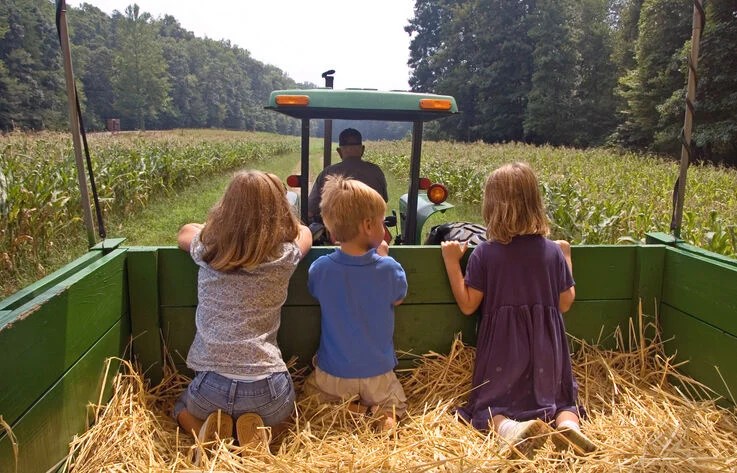
Several years ago, many owners of small farms in America began to reduce their crop production to a mere sideline and instead started using their property for another purpose: entertainment farming. Other terms for this new way to make a living on the farm are agritainment and agritourism.
Entertainment farmers attract paying customers to their property with country music bands, hay bale mazes, petting corrals, and tricycle courses. City-dwelling families eager for a feel of life on the farm were willing to pay a good price for admission, food and amusements. Extra options were also available. For instance, for an additional dollar a child could frolic in a pile of straw or pick a real live flower. Some farmers cut mazes into their cornfields that might take a person 45 minutes to navigate.
These ventures proved to be quite profitable for many entrepreneurs. One farmer reportedly made up to $15,000 on a good weekend.
In 1994 Alaska and Oklahoma introduced agritourism as official parts of their state tourism policies.
The primary reason for farmers to branch out into agritourism was the economic pressures they were facing. They were having a difficult time making a profit with traditional farming practices. This new way of making money seemed promising, and the risk was minimal.
Sometimes there is a danger of a church resembling an entertainment farmer. It could be easy to fall into the trap of trying to entertain people rather than focus on the central purpose of producing a crop. Jesus didn’t tell us to go out and entertain people. He said that we were supposed to make disciples. While there is nothing inherently wrong with being interesting, fruitfulness is God’s will for every Christian and every church. Let’s make sure that we don’t get involved in too many sideline activities at the risk of neglecting our mission.
“Let us not become weary in doing good, for at the proper time we will reap a harvest if we do not give up.”—Gal.6:9.
 Jesustrek