
There is a story told about a church that was struggling financially. The preacher asked one of the members to take on the responsibility of overseeing the congregation’s finances. The man, who was the manager of the local grain elevator, agreed, but only on two conditions: No report would be due for a year, and no one would ask any questions during the year. Since the man was known to be a person of outstanding character, the church agreed to his conditions.
At the end of the year the man made his financial report. He had paid off the church debt of $200,000. He had also redecorated the church, doubled the congregation’s giving to missions and tripled the amount of money the church had in the bank.
The shocked congregation asked, “How did you manage to accomplish all this?”
He answered, “You people bring your grain to my elevator. As you did business with me, I simply withheld 10 percent and gave it to the church. And you never missed it.”
“Bring the whole tithe into the storehouse, that there may be food in my house. ‘Test me in this,’ says the Lord Almighty, ‘and see if I will not throw open the floodgates of heaven and pour out so much blessing that there will not be room enough to store it.’”—Malachi 3:10.
A man was driving down the road one day when he saw a car with a flat tire parked on the shoulder. A woman was looking down in dismay at the flat tire. The man decided to play the part of the Good Samaritan and pulled over to help. He grew hot and sweaty and dirty as he changed the tire. As he finished, the lady said, “Be sure to let the jack down easily now, because my husband is sleeping in the back seat of the car!”
Labor Day reminds us that there is a time to work and a time to rest. Let’s make sure we find ourselves responding appropriately!
“We do not want you to become lazy, but to imitate those who through faith and patience inherit what has been promised.”—Hebrews 6:12.
According to recent reports, something called “quiet quitting” is taking the workplace by storm. This new trend is in the wake of many people literally quitting their jobs to pursue other ventures, or perhaps to just spend some time not working at all.
In “quiet quitting”, however, the workers do not actually leave their jobs. Instead, they continue to show up for work and draw a paycheck, but they do the absolute least amount of work they can get by with without getting fired. It remains to be seen how widespread this movement is and how greatly it might affect overall productivity in the economy of the United States. However, “quiet quitting” promises to have a negative effect on the lives of many people.
One could make a case that many people are “quiet quitting” the church. Many people dropped out of church during the pandemic, using it as an excuse to do what they already had a desire to do—quit the church.
However, many professed followers of Christ have not disappeared; they have simply quietly quit. They show up for a minimum number of worship services, just enough to still be considered a regular member of the church. When they do show up, they are not really engaged in the worship services. They do not invite their friends to church. They do not offer their services in any ministry of the church. Yet, like the quiet quitting worker who still draws a paycheck, these church-goers still hope to get rewarded for their “performance”.
How different this is from the Christianity we see practiced in the Bible! The believers in the early church were diligent in their worship and service. They would never dream of trying to get by with the absolute minimum of activity. They went the extra mile to live for Jesus.
This is the type of Christianity we need to see practiced today. Let’s encourage believers to give all they can for the cause of Christ. No quiet quitting allowed!
“Therefore, my dear brothers and sisters, stand firm. Let nothing move you. Always give yourselves fully to the work of the Lord, because you know that your labor in the Lord is not in vain.”—1 Corinthians 15:58.
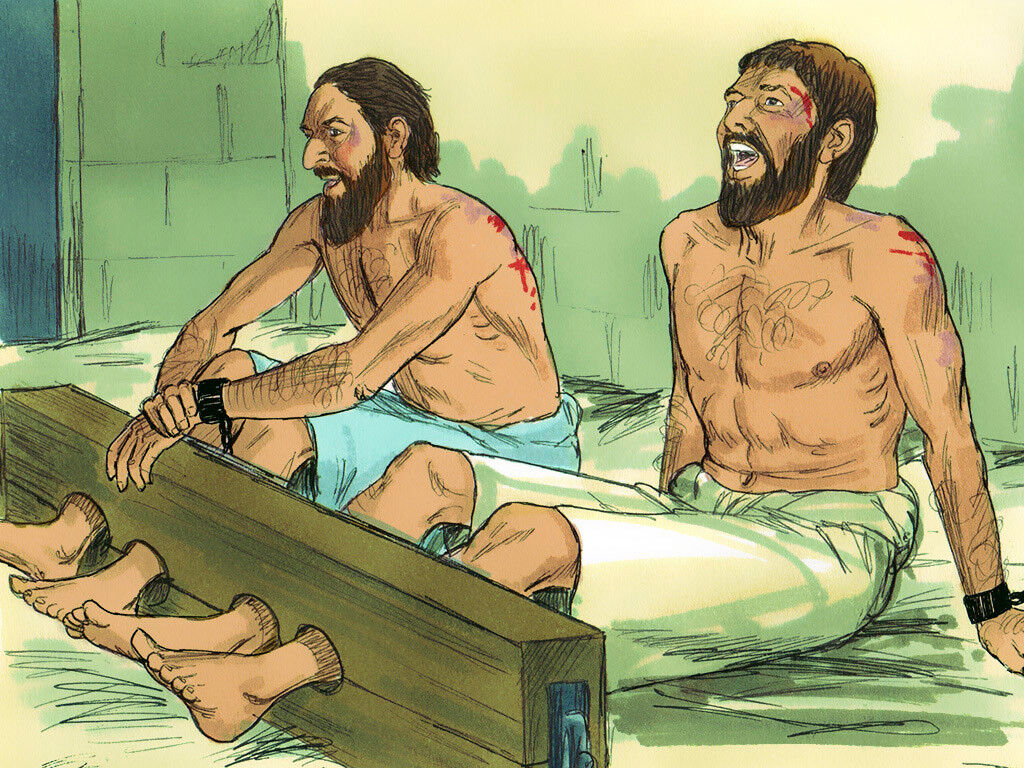
Acts 16 records a fantastic episode in the life of the apostle Paul. He and Silas had been falsely accused of committing some type of crime, when in fact all they had done was to minister in the name of Jesus Christ. Paul and Silas were severely flogged and thrown into prison, and the jailer was commanded to guard them carefully. This seems like an odd instruction. Aren’t all prisoners supposed to be guarded carefully? The authorities must have been well aware that Christian apostles had a tendency to escape from jail (Acts 5:18-19 and Acts 12:1-10). The jailer took his orders seriously. He put Paul and Silas in the inner cell and fastened their feet in the stocks.
Such an unfortunate turn of events might discourage many people from worshipping God, but Paul and Silas prayed and sang hymns to God. The other prisoners were listening to them.
Suddenly there was a violent earthquake. Now earthquakes are often signs of the presence of God, and this was just such a case. God was working miraculously to free the Christian missionaries. The prison doors opened and everyone’s chains came loose.
The jailer woke up and saw what had happened. He thought that the prisoners had escaped, so he was about to kill himself. He would rather take his own life than face the wrath of the authorities who would be quite disappointed that the prisoners had escaped.
But Paul shouted out, urging the jailer not to harm himself because the prisoners were all still there. Calling for lights, the jailer rushed in and found that it was just as Paul had said. Then the jailer fell trembling before Paul and Silas and asked, “Sirs, what must I do to be saved?”
They told him to have faith in Jesus, and then they spoke the word of the Lord to him and to all the others in his house. This might include household servants as well as relatives. They all believed the gospel message, and the repentant jailer and all of his household were immediately baptized into Christ. The jailer and his whole household were filled with joy because they had come to a saving faith in Jesus Christ.
From this story we see the great importance of worship. Hurting and unjustly imprisoned, Paul and Silas would not be deterred from praying and singing. Never allow your mood or your circumstances to prevent you from doing what you were created to do—worship God!
We also notice that other people are affected by our worship. Others were listening to the songs and prayers. The jailer was probably among those who heard the worshipping prisoners, and their witness would soon bear fruit.
We also see that a true encounter with God leads one to ask an extremely important question—“What must I do to be saved?” God’s saving grace offered to mankind through Jesus Christ is the whole point of the Bible! Please, don’t miss this point!
Finally, we see how a seeker of the truth is to respond to the gospel message. The jailer and his household were baptized immediately. They were not told to ask Jesus into their heart, or to pray a “sinner’s prayer” or to perform some other manmade ritual that cannot be found anywhere in Scripture. They were told to do what everyone who believes in the crucified and resurrected Jesus and wants to be saved did in the Bible—they were baptized.
So, let’s not underestimate the power of our worship. It bears testimony of God’s saving grace. When we worship, others can hear the gospel message of salvation through Jesus and respond appropriately.
“And now what are you waiting for? Get up, be baptized and wash your sins away, calling on his name.”—Acts 22:16.
The above photograph taken from a spot on I-80 in Wyoming shows why this road is called the “Highway to Heaven”. It looks like you can drive right up into the clouds…and beyond!
This picture serves to remind Christians that Jesus is the only way to heaven. Many people think that there are other ways to get to heaven, but they are wrong. Jesus does not give us any other options. He plainly teaches that all other roads will lead to eternal disappointment.
“Jesus answered, ‘I am the way and the truth and the life. No one comes to the Father except through me.’”—John 14:6.
I walked into a public restroom today and noticed a machine that dispenses condoms. The advertising slogan on the machine caught my eye— “When life just can’t wait.”
Sadly, that’s the philosophy of many people in the world today. Those who are not filled with the Holy Spirit see no need for putting off any pleasure that could be experienced immediately. They can’t comprehend the concept of delayed gratification. They know what they want and they know when they want it—right now.
How different it is for those who are filled with the Holy Spirit of God! The power of the Spirit enables them to be patient and wait for God’s timing before they engage in activities that are reserved exclusively for a husband and a wife within marriage. The Spirit gives them the ability to be in control of their body when they experience the desires that are common to nearly all humans.
Sometimes life needs to wait.
“If anyone is worried that he might not be acting honorably toward the virgin he is engaged to, and if his passions are too strong and he feels he ought to marry, he should do as he wants. He is not sinning. They should get married.”—1 Corinthians 7:36.
“But the fruit of the Spirit is love, joy, peace, forbearance, kindness, goodness, faithfulness, gentleness and self-control…”—Galatians 5:22-23.
In a recent column, Dear Abby gave this advice to someone who asked for direction in choosing between religions—“…consider which religion meets your needs…”
Unfortunately, that’s the way many people think when they are seeking religion. They are looking for an institution that will serve them. The consumer mindset is far too prevalent among religious seekers today. They are more concerned with what a church can do for them than what they can do for the church.
The key to choosing a religion is to find a church that gets its truth from the source—Jesus Christ.
“Jesus answered: ‘I am the way and the truth and the life. No one comes to the Father except through me.’”—John 14:6.
During a 1957 Philadelphia Phillies baseball game, batter Richie Ashburn hit a foul ball into the stands, breaking the nose of a female fan. When play resumed, Ashburn hit the woman again with another foul ball as she was being carried off on a stretcher! Talk about adding insult to injury!
Life can be hard sometimes. Paul the apostle often recounted the hardships that he had to face as he spread the gospel message. (See 2 Corinthians 6:3-10 for an example.) Jesus warned us that life would not always be easy. But even in the midst of life’s worst trials, we can experience the peace of God because we know that Jesus is ultimately in charge.
“I have told you these things, so that in me you may have peace. In this world you will have trouble. But take heart! I have overcome the world.”—John 16:33.
While in prison, Joseph gained a reputation for being able to interpret dreams (Genesis 40). When Pharaoh had some disturbing dreams, he was told about a prisoner who might be able to give him an interpretation, so he called for Joseph. God enabled Joseph to explain to Pharaoh that the dreams meant that there would be seven years of abundant crops, followed by seven years of terrible famine.
Joseph not only interpreted the dreams for Pharaoh, he also gave him a plan for how to survive the coming famine. He suggested that they store up food from the years of abundance and hold it in reserve to see them through the lean years.
Pharaoh not only thought that this was a good idea, but he also gave Joseph the responsibility of executing the plan. Joseph was put in charge of the whole land of Egypt, second only to Pharaoh himself (Genesis 41).
Joseph’s family was also affected by the famine, and they came to Egypt to buy food in order to survive (Genesis 42). Thus, Joseph was instrumental in keeping alive the young Israelite nation, through whom the Savior of the world, Jesus, would come.
From this episode we learn the importance of planning ahead. When God brings success to our plans, we help others in ways that we can’t even imagine. It’s all a part of God’s plan to save the world through Jesus. And he so graciously allows us to be a part of His plan!
“And whatever you do, whether in word or deed, do it all in the name of the Lord Jesus, giving thanks to God the Father through him.”—Colossians 3:17.
Joseph’s brothers had cruelly sold him into slavery. Years later, Joseph found himself second-in-command in Egypt. Furthermore, he was in charge of the food that Egypt had stockpiled to get them through the famine that had been predicted. When his brothers found it necessary to travel to Egypt in order to buy food for their survival, Joseph found himself in a position to pay them back for their terrible sin against him. However, Joseph chose to forgive them instead. Genesis 50:19-21 says, “But Joseph said to them, ‘Don’t be afraid. Am I in the place of God? You intended to harm me, but God intended it for good to accomplish what is now being done, the saving of many lives. So then, don’t be afraid. I will provide for you and your children.’ And he reassured them and spoke kindly to them.”
Forgiveness is a critical part of living out our faith in Jesus. When we forgive those who have done us wrong, we are following in the steps of our Savior Jesus, who died on the cross to make forgiveness possible for all sinners who will respond to him in faith.