There is a story told about a man who decided to become a monk. He joined a monastery that required its members to take a vow of silence. At the end of each year’s service this man would be allowed to say two words.
After the first year the man was allowed to speak his two words. He said, “Bed hard.”
After his second year of living at the monastery the man uttered these two words—“Food bad.”
At the end of his third year, the frustrated monk said, “I quit!”
His supervisor replied, “I’m not surprised. Ever since you got here you’ve done nothing but complain.”
“Do everything without grumbling…”—Philippians 2:14.
There has been some controversy surrounding President Joe Biden’s recent visit to Saudi Arabia. While there he was photographed fist-bumping several high-ranking Saudi officials. Some feel that it was an improper display that perhaps showed some acceptance of a murderous regime. Should one appear to be so friendly with people who are guilty of having blood on their hands?
Only time will tell if the Saudis experience any backlash from appearing to be so cozy with the pro-abortion Biden.
“Do not be misled: ‘Bad company corrupts good character.’”—1 Corinthians 15:33.
Tonight is Major League Baseball’s annual All-Star Game. This year’s game will be played in Los Angeles. You may remember that last year’s game was scheduled to be played in Atlanta, but was moved to Denver. Major League Baseball said that the move was in response to Georgia’s new voting law. The left, and President Joe Biden in particular, called the new law “Jim Crow 2.0”, insisting that the result would be to suppress the vote, especially of minority voters. Major League Baseball bought into the left’s narrative and made their knee-jerk decision to move the All-Star Game.
If you followed the issue, you will know that the voter turnout in Georgia for the primaries this spring was actually much higher than recent elections. It seems that the law did exactly what it was intended to do—to make it easy to vote and hard to cheat.
Meanwhile, Major League Baseball played their All-Star Game last year in Colorado, a state that actually has more restrictive voting laws than Georgia.
If MLB has issued an apology to the city of Atlanta, I missed it. Perhaps they are waiting until tonight’s game, when their apology can be heard by a large audience.
I wish that MLB would stay out of politics. But if they have to get involved, they should at least try to get it right.
“To answer before listening—that is folly and shame.”—Proverbs 18:13.
My neighbor recently cut down a dying walnut tree that had become a nuisance. Even though the tree was nearly dead, it still produced a few nuts last year. I helped myself to a few of the walnuts and kept them for a while. After he cut down the tree, I decided to try the nuts to see if they were still any good. About half of them were still edible. I enjoyed eating the nuts, even after the tree’s demise.
This made me think about a verse in the Bible that talks about how we Christians bear lasting fruit. Revelation 14:13 says, “Then I heard a voice from heaven say, ‘Write this: Blessed are the dead who die in the Lord from now on.’ ‘Yes,’ says the Spirit, ‘they will rest from their labor, for their deeds will follow them.’”
Our words and actions will be remembered by those who remain after we are gone. We have many opportunities to continue to make an impact for the Lord long after we have passed from this life to the next. Let’s strive to produce fruit that will last.
I recently read a pro-abortion newspaper article that began with this statement—“If you oppose abortion, do not have one.” No doubt the writer thought that she had said something so profound that her wisdom could not be refuted. Her statement reminded me of similar comments made by those who defend the homosexual lifestyle—“If you are against gay marriage, don’t ask a gay person to marry you.”
Their line of thinking goes like this—If you think that a certain behavior is wrong, the only recourse that you have is to refrain from engaging in that particular behavior. Any other action that you might take is off limits. You may not speak against the offensive behavior, nor may you attempt to prevent others from making the mistake of engaging in that behavior. In other words, mind your own business.
Let’s see if that reasoning holds up if we apply it to other sins besides abortion and homosexual behavior. Suppose you think that it’s wrong to sell illegal drugs to children on the playground. Is it true that your only choice is to refrain from selling drugs to children yourself? Of course not! You can lobby for laws against that practice to be passed and enforced. You can report suspicious activity to the authorities. You can warn children about the dangers of drugs and interacting with strangers.
Or let’s say that you believe that immigration laws should be obeyed. Does that mean that your only option regarding this issue is to avoid entering a country illegally yourself? Of course not! There are other legitimate ways that you can take a stand on this issue.
The idea that the only legitimate way to oppose wicked behavior is to avoid that behavior yourself is ridiculously absurd. So how can the pro-abortion and pro-homosexual zealots come to such illogical conclusions? It is because they have aligned themselves against God. Psalm 111:10 says, “The fear of the Lord is the beginning of wisdom; all who follow his precepts have good understanding. To him belongs eternal praise.” Since there is no true wisdom without the fear of the Lord, those who oppose God are incapable of attaining true wisdom and understanding. Romans 1:21-22 describes these people—“For although they knew God, they neither glorified him as God nor gave thanks to him, but their thinking became futile and their foolish hearts were darkened. Although they claimed to be wise, they became fools.”
This is why people who defend—and even celebrate—violence and perversion can say such illogical things and think that they have a winning argument. Their opposition to God has rendered them fools who are incapable of having a logical conversation. It is impossible to reason with people who did not use reasoning to reach their current position.
However, we must not remain silent on important moral issues. Where God has clearly spoken, we must speak. While we might not ever convince those who have aligned themselves against God, we can have some positive influence on people who have honest questions and are looking for some biblical perspective on moral issues.
The headline of a story on page four of today’s edition of the Lexington Herald-Leader read—“Pet adoption, fostering could move state toward no-kill”. This seems like a direction that would be agreeable to almost everyone. Who wouldn’t be in favor of allowing cute little animals to continue living?
Ironically, this liberal newspaper often proclaims the virtues of abortion—insisting that ending the life of a baby in its mother’s womb constitutes health care for women and insinuating that the only people who stand for the pro-life movement are narrow-minded, mean-spirited women haters.
Why can’t we offer the same kindness and mercy to tiny human beings that we do to our furry little friends?
Hopefully, the recent Supreme Court decision to overturn Roe vs. Wade will help move our nation toward a no-kill policy for babies in the womb.
“Rescue the weak and the needy; deliver them from the hand of the wicked.”—Psalm 82:4.
Sometimes people accuse Christians of being narrow-minded. They say that followers of Jesus should have a broader view of moral and social issues. They even maintain that Jesus would not be so narrow-minded—that he would share their wider acceptance of liberal thoughts and behaviors. Nothing could be further from the truth.
The Jesus we see in Scripture has some sharply defined views on many issues. One might even call him narrow-minded. Let’s look at some examples.
Jesus has a narrow view of creation. In Mark 10:6 he says, “But at the beginning of creation God made them male and female.” Jesus doesn’t seem to leave room for macro-evolution, the idea that mankind finally emerged as a finished product after billions of years and a series of remarkably fortunate occurrences that saw one-celled creatures finally evolve into the human beings that we are today. Jesus says that we were created by God in the very beginning.
That same verse also shows that Jesus has a very narrow view of gender, at least compared with some of the ideas that are being thrown around today. I recently filled out a medical form that gave me the option of listing myself as male, female or other. I heard of a university that lists 8 different genders that their students can choose from! But Jesus has a limited view of gender—male and female.
Jesus also has a narrow view of marriage. In Mark 10:7 he says, “For this reason a man will leave his father and mother and be united to his wife, and the two will become one flesh. So they are no longer two, but one flesh.” Here Jesus quotes Genesis 2:24 and reaffirms God’s original definition of marriage—that it is a union between a man and a woman. Many in our society today would take a broader view of marriage, but Jesus does not offer that option.
When it comes to divorce, Jesus once again has a narrow view. When the Pharisees asked him if a man could divorce his wife “for any and every reason”, he answered, “…Therefore what God has joined together, let no one separate.” He went on to say that sexual immorality was the only legitimate grounds for divorce. (Matthew 19:1-9). Our culture mirrors the one that Jesus lived in during the first century, with its wide acceptance of divorce, but Jesus takes a narrow view.
Jesus has a narrow view of discipleship. While some would say it’s an easy thing to be a Christian, Jesus says that if we want to be his disciple we have to deny ourselves and take up our cross and follow him (Mark 8:34).
Jesus has a narrow view of morality. He implored the woman who was caught in adultery to leave her life of sin (John 8:11).
Jesus has a narrow view of membership in his kingdom. In Revelation 22:15 he says, “Outside are the dogs, those who practice magic arts, the sexually immoral, the murderers, the idolaters and everyone who loves and practices falsehood.”
Jesus has a narrow view of salvation. While some insist that there are many ways to God, Jesus proclaims in John 14:6, “…I am the way and the truth and the life. No one comes to the Father except through me.”
These are just a few of the examples we see in Scripture of how Jesus has a narrow view of what is right and true. So, the next time someone tries to insult you by calling you “narrow-minded” because of your Christian beliefs, be aware that they are unknowingly paying you a great compliment. Let’s all strive to agree with Jesus in all areas of life.
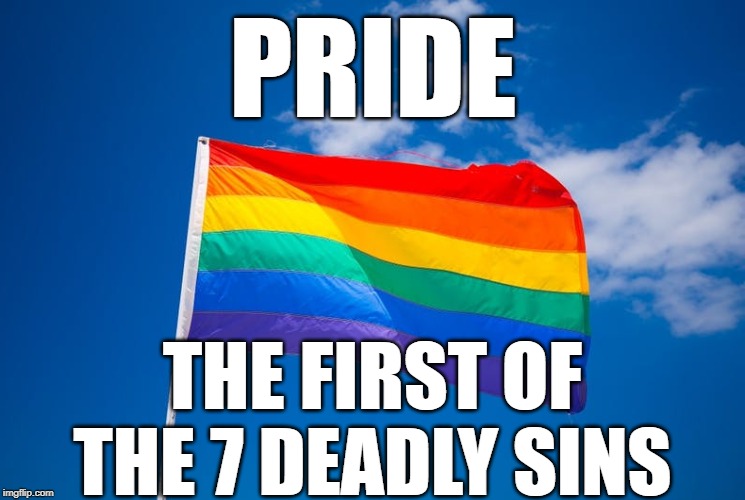
For the past several years homosexuals and their supporters have designated June as “Pride Month”, a time when the homosexual lifestyle is celebrated with various promotions and festivities. They are certainly welcome to choose to live their lives as they please. However, it seems that many of them expect Christians to join in the celebration and are quite offended when we don’t do that. As 1 Peter 4:4 says, “They are surprised that you do not join them in their reckless, wild living, and they heap abuse on you.”
Our culture is becoming more accepting of homosexual behavior. The examples of this are numerous. Movies and television shows depict homosexual characters as being part of the new normal. News journalists and sports broadcasters gush over the “bravery” of athletes who come out as gay. Homosexual marriage has been legalized in the United States. The rainbow (which is supposed to be a sign of God’s promise, certainly not what some are depicting it to represent) is proudly displayed in many places. Even some liberal churches have made statements declaring that they “accept and affirm” the homosexual lifestyle.
Some people claim that Jesus never said anything against homosexual behavior. They could not be more wrong. First of all, Jesus consistently spoke against sexual immorality, and everyone to whom Jesus spoke understood that homosexual actions are included in those prohibitions. Secondly, Jesus is God, so all the Bible’s teaching against homosexual behavior comes directly from Jesus.
So how does a Christian respond to a culture that seems determined to oppose Jesus on this issue? The answer is that we must speak the truth in love (Eph.4:15). In order to do this, we must know the truth. There are many Scriptures, both Old and New Testament, that clearly and consistently point out God’s will in this matter. Know what the Bible says and be ready to defend the truth.
However, we must speak with love. Our desire is not to condemn people, but to win them to Jesus. If people think we hate them, they will not even listen to our message of hope and salvation, much less respond to it.
Here are a couple of thoughts to leave you with. First, don’t give up on anybody. People can change (1 Cor.6:9-11). Second, don’t be an enabler to anyone who is living an immoral life. Romans 1 speaks of the wrath of God that will be poured out upon the wicked. The last verse of that chapter also issues a dire warning to those who approve of the deviant practices of others.
Lately we have been watching old game shows on television. I mean shows from decades ago. (Yes, things are really that exciting at our house these days.) Today I couldn’t help but notice the enthusiasm shown by host Allen Ludden each time a contestant on “Password” did well. Ludden would shout “Yes!!” following each correct response. His excitement seemed genuine and heartfelt. You could tell that he really enjoyed his job.
If only we could show such enthusiasm as we do our various jobs in the kingdom of God!
“Never be lacking in zeal, but keep your spiritual fervor, serving the Lord.”—Romans 12:11.
Before he died on the cross to pay for the sins of humanity, Jesus promised that he would build his church (Matt.16:18). He is currently doing just that, and the building of his church is the most important project in the entire universe. So, let’s talk about the church. Using an acrostic, let’s try to describe the church.
CHRIST-CENTERED—The first “C” in church might stand for Christ-centered. Jesus bought the church with his own blood (Acts 20:28), so he is the rightful owner. He is the head of the church (Eph.4:15), so he has the authority to tell the parts of the body of Christ what to do. Sadly, congregations often become more like social clubs than true churches. They exist to satisfy the desires of the members rather than to obey the commands of Jesus. Any church that is serious about fulfilling its purpose will always strive to keep their focus on Jesus (Heb.12:1-3).
HOLY—The first “H” in church can remind us that we are called to be holy. “Holy” does not mean perfect; it means that we are set apart for God’s purposes. Christians do not look like the unholy people of the world in which we live. We are distinctive from them in the way that we think, speak and act. The congregation that does not take the holiness of its members seriously is headed down a dangerous path. A church cannot wink at sin and expect to enjoy the blessings of God. 1 Peter 1:15-16 says, “But just as he who called you is holy, so be holy in all you do; for it is written: ‘Be holy, because I am holy.’”
UNITED—For our purposes here, the “U” stands for united. Jesus prayed in John 17 that his followers would be united so that they could be a good witness to the world. The book of 1 Corinthians is filled with pleas for unity. Eph.4:1-16 is another text that calls for the church to be united in the same way that the parts of the human body work together as each part does its work. Causing division in the church is a terrible sin (1 Cor.3:17), therefore divisive people must be confronted (Titus 3:10-11).
REACHING OUT—The “R” in church can serve to remind us of our mission to reach out to people who need to come to Jesus for salvation. The gospels of Matthew and Mark both end with what we call the “Great Commission” to make disciples of all nations, baptizing them and teaching them to obey the commands of Jesus. Any congregation that neglects to reach out to the lost is doomed to die a slow and agonizing death.
COMPASSIONATE—Let’s say that the second “C” in church stands for compassion. Since we are the children of a loving heavenly Father, his love must be manifested in our lives. The greatest commandments according to Jesus are to love God and love people (Matt.22:34-40). As Christians, we are especially called to love one another with a Christ-like love that shows others that we truly are disciples of Jesus (John 13:34-35). And let us be reminded that true love is far more than feelings of sentimentality. Love is an action verb that often requires sacrifice on our part. Jesus says, “Greater love has no one than this: to lay down one’s life for one’s friends.” (John 15:13).
HEAVEN-BOUND—The second “H” in church can remind us of our eternal destination. Our citizenship is not of this world. This painful, sinful world is not our final destiny. Jesus has prepared a place for us where we can live in the presence of God forever (John 14:1-6). Rev.21:3-4 says, “And I heard a loud voice from the throne saying, ‘Look! God’s dwelling place is now among the people, and he will dwell with them. They will be his people, and God himself will be with them and be their God. He will wipe every tear from their eyes. There will be no more death or mourning or crying or pain, for the old order of things has passed away.” What a wonderful promise of Scripture! But until that promise is fulfilled, let us constantly be about the business of doing our best to see that God’s will is done on earth as it is in heaven, and that his church becomes more and more like the church he has designed us to be.










 Jesustrek